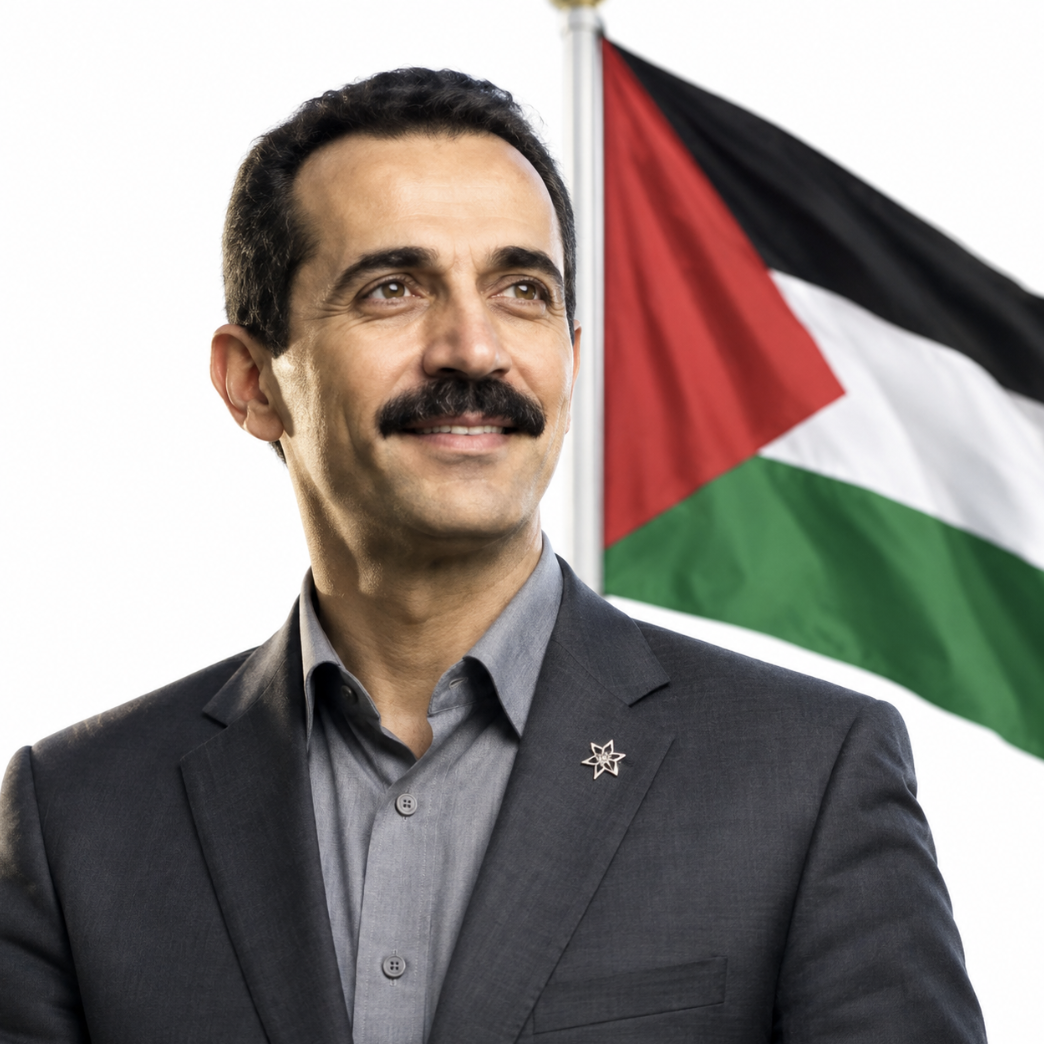
Palestine
Baha Baalusha
A senior advisor in regional and international strategic affairs
Profile written by journalist Sami Qasem
Baha Misbah Youssef Baalusha is a man who has made stability and serving humanity a path to peace.
Press report:
In an era where Palestinian crises have transcended the boundaries of politics and security, affecting homes, universities, schools, and the daily bread, the value of individuals who have chosen to place humanity at the heart of their responsibilities emerges, making social and economic stability a gateway to protecting society and enhancing its resilience.
Among these individuals, the name Baha Misbah Youssef stands out, whose experience, according to testimonies circulating among various segments of society about his journey, is linked to quiet work serving broad segments of Palestinian society, away from the limelight and media noise.
His slogan of stability began with human life.
Baha Misbah Youssef did not view stability merely as a security or political issue; rather, he treated it as a system that starts from the daily life of the citizen.
The family that loses its home or has part of it damaged due to wars needs someone to stand by them, the student whose parents cannot pay his university fees needs someone to help him continue his education, and the patient needs someone to support him in his treatment journey.
From this standpoint, he developed a vision that links stability, economy, and social service; because a society where individuals feel that there is someone standing by them in times of hardship is more capable of resilience and maintaining its cohesion.
Houses destroyed by wars... and a hand reaching out to restore life.
One of the most prominent humanitarian aspects associated with his name is his contribution to rehabilitating and redesigning several homes that suffered partial damage due to wars, in an attempt to help their owners return to their homes and regain part of their normal lives.
For the affected families, restoring a wall or repairing homes was not merely an engineering task; the home for Palestinians represents safety, privacy, memories, and belonging.
Therefore, contributing to the rehabilitation of a damaged home essentially means contributing to rebuilding the family's sense of safety and stability.
Dozens of treatment cases... away from the cameras.
His name is also associated, according to what is narrated about his humanitarian journey, with helping dozens of medical cases and providing support to those in need of treatment or care.
What is striking about these efforts is that they were not presented, as described by those who know this experience, as a means of appearing or achieving media gains, but rather often took place away from the cameras.
Here lies a different value in humanitarian work: to provide assistance because there is a person in need, not because there is an audience waiting for a scene or a picture.
Years of paying students' tuition fees.
Perhaps one of the most indicative files of this approach is helping students pay their school and university fees over the years.
For a low-income family, education can sometimes become a burden that exceeds its capacity, and a student may find himself threatened with leaving school due to fees that his family cannot afford.
In such cases, assistance in paying fees meant more than just settling a financial amount; it meant giving the student another chance to continue, preserve his future, and not allow economic circumstances to deprive him of education.
Help that seeks no applause.
Perhaps the most succinct phrase that encapsulates this experience is: giving in silence.
For years, this assistance has taken place away from the noise, without turning people's suffering into material for display.
This type of work leaves a different impact; because the needy person does not want his need to become a story circulated by others, but rather wants to find someone who preserves his dignity and offers him help without making him feel indebted to anyone.
Youth, workers, the poor, and people with disabilities.
This perspective did not limit itself to one segment of society but extended to various groups, from students and youth to workers, poor families, the needy, and people with disabilities and special needs.
Here, social work becomes part of a broader concept of stability: that every individual, regardless of their social or economic status, feels they are part of society and have a right to a decent life, education, treatment, and housing.
When position turns into responsibility.
Positions and authorities can be mere administrative tools, but they become valuable when they transform into genuine service to the people.
This experience indicates that Baha Misbah Youssef tried to make his position and capabilities a means to reach out to people and assist them, linking economic and social stability with building a calmer environment capable of enduring crises.
Peace does not always begin in negotiation halls; sometimes it starts from a house being restored, a student continuing in university, a patient finding someone to help him, a poor family preserving its dignity, and a person with a disability finding someone to stand by him.
A human before being a responsible person.
Ultimately, the image that these works paint of Baha Misbah Youssef Baalusha is that of a man who sees that the value of responsibility is not measured only by the powers its holder possesses, but by what he offers to people in terms of impact.
Rehabilitating a damaged house, helping a patient, paying a student's fees for years, and standing by the poor and those with special needs are all acts that may not appear in news bulletins, but they remain present in the memory of their beneficiaries.
In a world where the voice of appearances rises, the silent giving remains one of the most sincere forms of human responsibility, because some deeds do not need a camera to be great; it is enough to change a person's life for you to receive all the love, O Baha of the needy and the poor.